7 Best Credit Card Processing Companies for Small Businesses in 2026
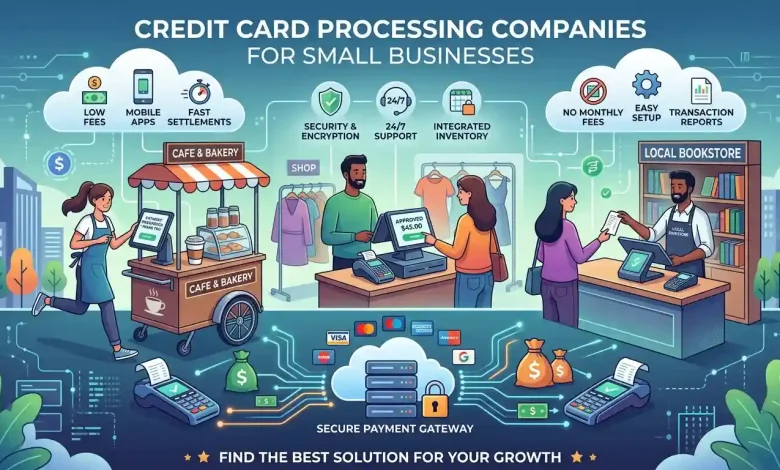
Table of Contents
Credit Card Processing Companies have become an indispensable part of the modern small business landscape. In an increasingly cashless society, the ability to accept electronic payments is no longer a luxury but a fundamental necessity for businesses aiming to stay competitive and meet evolving customer expectations. From bustling retail shops and dynamic restaurants to burgeoning e-commerce platforms and mobile service providers, consumers today anticipate a seamless, secure, and flexible payment experience. Failing to offer credit and debit card processing can result in lost sales, reduced customer satisfaction, and a significant competitive disadvantage.
For small businesses, navigating the complexities of credit card processing can seem daunting. The industry is rife with intricate terminology, varying fee structures, and a multitude of providers, each claiming to offer the best solution. Understanding how these systems work, what factors influence costs, and which companies are best suited for specific business models is crucial for making an informed decision that directly impacts profitability, cash flow, and overall operational efficiency. This comprehensive guide will demystify credit card processing for small businesses, providing insights into its mechanics, key considerations for choosing a provider, an overview of leading companies, and the vital importance of security and compliance.
How Credit Card Processing Works: A Step-by-Step Breakdown
Understanding the fundamental mechanics of credit card processing is the first step toward selecting the right provider for your small business. While the transaction itself often appears instantaneous to the customer, a complex series of interactions occurs behind the scenes, involving multiple entities to ensure the secure and successful transfer of funds.
Key Players in a Credit Card Transaction
- Customer: The individual initiating the purchase with their credit or debit card.
- Merchant: Your business, accepting the payment.
- Point-of-Sale (POS) System/Payment Terminal: The physical device (like a card reader) or software (like an online checkout) where the transaction is initiated. This system encrypts the card data to protect sensitive information.
- Payment Gateway: This acts as a secure bridge between your POS system or website and the payment processor. It encrypts and transmits the transaction data securely.
- Payment Processor: This entity manages the entire transaction process. It routes transaction data through the appropriate card networks and coordinates the approval or denial of the transaction.
- Card Networks: Major networks like Visa, Mastercard, American Express, and Discover. They connect the issuing and acquiring banks and set the rules for transactions.
- Issuing Bank: The customer’s bank that issued the credit or debit card. It approves or declines the transaction based on the customer’s available funds or credit and fraud risk.
- Acquiring Bank: This is the merchant’s bank partner in the card transaction. It receives funds from the card network on behalf of your merchant account.
- Merchant Account: A specialized bank account that temporarily holds funds from credit card sales before they are transferred to your business’s regular bank account. Some payment service providers (PSPs) aggregate transactions under a single merchant account rather than requiring each merchant to have their own.
The Transaction Flow
- Transaction Initiation: A customer presents their card (swipes, dips, taps, or enters details online) at your POS or checkout system.
- Data Encryption & Transmission: The POS system or payment gateway encrypts the card data and sends it to the payment processor.
- Authorization Request: The payment processor forwards the encrypted transaction details to the relevant card network, which then sends it to the customer’s issuing bank for approval.
- Approval or Decline: The issuing bank assesses the transaction (checking for sufficient funds/credit, fraud risk) and sends an approval or decline message back through the card network to the processor.
- Notification: The processor relays the authorization status back to your POS system, completing the immediate customer-facing part of the transaction.
- Batching & Settlement: At the end of the business day, approved transactions are typically grouped (batched) and sent by the processor for final settlement. The card networks confirm these records, and the issuing banks transfer funds to the acquiring bank.
- Funding: The acquiring bank deposits the funds, minus any applicable processing fees, into your merchant account, and then typically to your regular business bank account, usually within one to five business days.
While this process may appear intricate, modern payment processing systems are designed to handle these steps efficiently and securely, enabling small businesses to accept payments seamlessly.
Key Factors to Consider When Choosing a Credit Card Processor
Selecting the right credit card processing company is a pivotal decision for any small business, directly impacting profitability, operational efficiency, and customer satisfaction. With a multitude of options available, a careful evaluation of several key factors is essential to ensure you choose a provider that aligns with your specific needs and growth trajectory.
Cost and Fee Structures
Credit card processing fees are an unavoidable cost, but they can vary significantly between providers. Transparency in pricing is paramount; hidden fees can quickly erode profit margins. Most small businesses can expect to pay between 1.5% and 3.5% per transaction, though this can reach up to 5% for certain transaction types.
- Transaction Fees: These are charged per transaction, often a percentage plus a fixed amount (e.g., 2.9% + $0.30). Rates can differ based on card type (debit vs. credit), card brand (Visa, Mastercard, American Express), and the payment method (swiped, inserted, tapped, or keyed-in). In-person transactions generally have lower fees due to lower risk.
- Monthly Fees: Some processors charge fixed monthly fees for statements, payment gateways, or minimum processing volumes.
- Setup and Equipment Fees: Initial costs for account creation or purchasing/leasing POS systems and card readers should be considered.
- PCI Compliance Fees: Some providers charge an annual or monthly fee to help ensure your business adheres to Payment Card Industry Data Security Standard (PCI DSS) requirements.
- Chargeback Fees: Incurred when a customer disputes a transaction. These can range from $15 to $20 per chargeback, regardless of the outcome.
- Hidden Fees: Always scrutinize contracts for less obvious charges, such as statement fees, batch fees, or annual account fees. A transparent provider will make all fees clear upfront.
Contract Terms and Flexibility
Be wary of long-term contracts with hefty early termination fees. Many modern processors offer month-to-month agreements, providing greater flexibility as your business evolves. This is particularly beneficial for startups or seasonal businesses where transaction volumes might fluctuate. Review terms regarding automatic renewals and cancellation policies carefully.
Ease of Use and Integration
The system should be intuitive for both you and your employees. Look for user-friendly interfaces, simple setup processes, and reliable hardware. seamless integration with existing business software, such as accounting platforms (e.g., QuickBooks), inventory management systems, or e-commerce platforms, can significantly streamline operations and reduce manual data entry.
Customer Support and Reliability
Payment processing issues can be critical. Assess the quality and availability of customer support. Do they offer 24/7 support? Is it easy to reach a live person? A responsive and knowledgeable support team is invaluable for resolving technical glitches, chargeback disputes, or other transaction-related inquiries quickly, minimizing disruption to your business.
Security and Compliance
Protecting sensitive cardholder data is non-negotiable. Ensure the processor adheres to PCI DSS standards and offers robust security features like encryption, tokenization, and real-time fraud detection. The processor should also assist you in maintaining your own PCI compliance.
Scalability and Value-Added Services
Choose a processor that can grow with your business. If you plan to expand online, open new locations, or introduce subscription services, the processor should support these changes seamlessly. Many providers offer additional services like fraud protection, customer data analytics, recurring billing, invoicing, and loyalty programs, which can add significant value.
Business Type and Payment Methods
Consider your business model (retail, e-commerce, mobile, service-based) and the payment methods your customers prefer. Your processor should support a wide range of options, including credit and debit cards, mobile wallets (Apple Pay, Google Pay), and contactless payments. Some providers specialize in particular niches, offering tailored solutions.
Understanding Credit Card Processing Pricing Models
The way a credit card processor charges for its services is encapsulated in its pricing model. This is one of the most critical aspects to understand, as it directly impacts your overall processing costs. There are generally three main pricing models: Flat Rate, Interchange Plus, and Tiered Pricing.
Flat-Rate Pricing
Flat-rate pricing is perhaps the simplest and most straightforward model, often favored by small businesses with lower transaction volumes or those new to credit card processing. With this model, you pay a fixed percentage plus a small fixed amount per transaction, regardless of the card type or method used.
- How it works: The processor charges a consistent rate, for example, 2.9% + $0.30 for online transactions or 2.6% + $0.10 for in-person transactions. Companies like Square, Stripe, and PayPal commonly use this model.
- Pros:
- Predictability: Costs are easy to estimate, simplifying budgeting and financial planning.
- Simplicity: Easy to understand and manage, with no complex breakdowns of different card types.
- Ideal for: Businesses with many small transactions, startups, or those with fluctuating monthly volumes.
- Cons:
- Potentially Higher Cost: While simple, flat-rate pricing may not always be the lowest-cost option, especially for high-volume businesses or those processing many debit cards, which typically have lower interchange fees. The flat rate needs to cover the processor’s costs across all card types, so it’s often set higher than the average interchange fee.
- Less Transparency: The actual interchange and assessment fees are bundled into the flat rate, making it difficult to see the underlying costs.
Interchange-Plus Pricing
Considered the most transparent pricing model, interchange-plus pricing separates the actual interchange fees and card network assessment fees from the payment processor’s markup.

- How it works: You pay the direct interchange fee (set by card networks like Visa and Mastercard) and assessment fees, plus a fixed markup from your processor (e.g., interchange + 0.3% + $0.10). This means the fee per transaction can vary based on the specific card used.
- Pros:
- Transparency: You clearly see what you’re paying to the issuing bank/card network and what the processor is charging as their markup.
- Cost-Effectiveness: Often the most cost-effective option for businesses with higher transaction volumes, as the markup is usually lower. As processing volumes increase, businesses may have more negotiating power to reduce fees.
- Negotiation Power: Better for negotiating rates as your business grows.
- Cons:
- Complexity: Can be more complex to understand due to varying interchange rates for different card types.
- Volatility: Monthly costs can fluctuate more depending on the types of cards your customers use.
- Ideal for: Businesses with higher transaction volumes (often over $10,000 per month) seeking maximum cost efficiency and transparency. Helcim is an example of a processor known for this model.
Tiered Pricing
Tiered pricing categorizes transactions into different rate tiers, such as “qualified,” “mid-qualified,” and “non-qualified,” each with its own rate.
- How it works: The processor assigns different rates based on transaction characteristics. “Qualified” transactions (e.g., standard debit cards, card-present) typically have the lowest rates. “Mid-qualified” (e.g., rewards cards, keyed-in transactions) are more expensive, and “non-qualified” (e.g., high-rewards cards, international cards, corporate cards) carry the highest rates.
- Pros:
- Can offer competitive rates for specific card types if most of your transactions fall into the “qualified” tier.
- Cons:
- Lack of Transparency: This model is often the least transparent and can be confusing, making it difficult to predict costs. Processors have discretion in classifying transactions, which can lead to higher-than-expected fees.
- Unpredictability: It’s hard to control which tier a transaction falls into, making costs unpredictable.
For most small businesses, flat-rate pricing offers simplicity, while interchange-plus provides greater transparency and potential savings for higher volumes. Tiered pricing is generally less recommended due to its lack of transparency.
Top Credit Card Processing Companies for Small Businesses
The market for credit card processing companies is dynamic, with various providers offering solutions tailored to different business needs. While the “best” company can depend heavily on your specific business type, transaction volume, and preferred pricing model, several stand out for their features, reliability, and popularity among small businesses. Below is a comparison of some leading options, highlighting their strengths.
| Company | Best For | Typical Pricing Model | Key Features & Benefits | Considerations |
|---|---|---|---|---|
| Square | Mobile, in-person (retail, food trucks), startups, small businesses needing integrated POS. | Flat-rate: e.g., 2.6% + $0.10 for in-person; 2.9% + $0.30 for online. | Free POS software. User-friendly hardware (card readers, terminals, registers). Next-day deposits. Integrated inventory management, sales analytics, employee management. No long-term contracts. | Flat rates can be more expensive for high-volume businesses or those processing many debit cards. Chargeback fee of $15. |
| Stripe | Online businesses, e-commerce, tech-savvy businesses, SaaS, complex payment flows, global reach. | Flat-rate: e.g., 2.9% + $0.30 for online; 2.7% + $0.05 for in-person. Volume discounts available for high-volume businesses. | Robust API for customization and advanced integrations. Supports 135+ currencies and 40+ countries. Strong for subscriptions and recurring billing. Advanced fraud prevention tools. | Designed for developers, so may have a steeper learning curve for non-technical users. In-person hardware offerings are more limited than Square. Charges $15 chargeback fee, win or lose. |
| PayPal Zettle (for in-person) / PayPal (for online) | Small businesses with existing PayPal accounts, freelancers, e-commerce, businesses needing strong brand recognition. | Flat-rate: e.g., 2.9% + $0.30 for online; 3.49% + $0.49 for manually entered transactions. PayPal Zettle offers competitive in-person rates. | Seamless integration with PayPal accounts. Trusted brand recognition, which can boost conversion rates. Supports various payment methods including PayPal Credit and Venmo. Strong for international reach, operating in 200+ countries. | Online rates can be slightly higher than Stripe/Square for equivalent transactions. Highest chargeback fee at $20. |
| Helcim | Small to medium-sized businesses prioritizing cost control and pricing clarity, high-growth companies. | Interchange-plus pricing, with clear separation of card network fees and Helcim’s markup. | Transparent pricing model often results in lower overall costs for consistent transaction volumes. No long-term contracts, no monthly fees, no cancellation fees. Virtual terminal, invoicing, online store builder included. Good customer support. | May be less suitable for very low-volume businesses where flat-rate simplicity is preferred over detailed transparency. |
| Clover | Retailers, restaurants, service businesses seeking an all-in-one POS system. | Varies, often subscription-based with transaction fees. | User-friendly POS hardware (Clover Go, Flex, Mini, Station). Comprehensive software options for inventory, employee management, reporting. Accepts all forms of payment. | Can be more expensive for the full hardware and software ecosystem. May require a separate merchant account. |
Merchant Account vs. Payment Service Provider (PSP)
When choosing a processing solution, small businesses will often encounter the terms “merchant account” and “Payment Service Provider (PSP).” While both enable you to accept credit cards, they operate differently.
- Merchant Account: This is a dedicated bank account that holds funds from credit card sales before they are transferred to your business’s regular bank account. You establish a direct agreement with an acquiring bank.
- Pros: Often results in lower rates for high-volume businesses due to individual underwriting and risk assessment. More flexibility in terms and conditions.
- Cons: Requires a more rigorous application and vetting process. Can involve more setup time and potentially higher monthly fees.
- Ideal for: Established businesses with high transaction volumes and a stable financial history looking for the lowest possible rates.
- Payment Service Provider (PSP): A third-party company that enables businesses to accept electronic payments by aggregating multiple merchants under a single, large merchant account. Popular examples include Square, Stripe, and PayPal.
- Pros: Quicker and simpler setup process, especially for new businesses or those with lower volumes. Often comes with flat-rate pricing, making costs predictable.
- Cons: Can be more expensive for high-volume businesses compared to a dedicated merchant account. Less flexibility in negotiating rates. If other merchants under the same aggregated account have high chargeback rates or fraud, it could potentially impact your business.
- Ideal for: Startups, small businesses, and e-commerce ventures looking for ease of use, fast setup, and transparent pricing without the complexities of a dedicated merchant account.
The Critical Role of Security and PCI Compliance
In the realm of credit card processing, security is not just a feature; it is a fundamental requirement. Protecting sensitive customer data is paramount, not only to maintain trust and reputation but also to avoid severe financial and legal repercussions. This is where the Payment Card Industry Data Security Standard (PCI DSS) comes into play.
What is PCI DSS?
PCI DSS is a set of security standards established by the Payment Card Industry Security Standards Council (PCI SSC), formed by major credit card brands like Visa, Mastercard, American Express, Discover, and JCB. These standards dictate how businesses must securely store, process, and transmit cardholder data to prevent data breaches and fraud. Compliance is mandatory for any business that accepts credit or debit card payments, regardless of its size or whether it stores card information.
Why PCI Compliance Matters for Small Businesses
- Mandatory Requirement: While not a federal law, PCI DSS compliance is a contractual obligation required by all major credit card brands and banks that process payments. Without it, you cannot legally process card transactions.
- Data Breach Prevention: Adhering to PCI DSS significantly reduces the risk of data breaches, which can be devastating for a small business. Breaches lead to financial losses, reputational damage, and loss of customer trust.
- Avoid Penalties and Fines: Non-compliance can result in substantial fines and penalties from card brands and acquiring banks, ranging from thousands to hundreds of thousands of dollars, depending on the severity and duration of non-compliance.
- Enhanced Customer Trust: Demonstrating a commitment to data security builds confidence with your customers, encouraging them to use their cards at your business.
- Legal Protection: In the event of a breach, being PCI compliant can offer some level of protection against legal liability.
PCI Compliance Levels
PCI DSS has four compliance levels, determined by the number of card transactions a merchant processes annually. Most small businesses fall into Level 4, processing fewer than 20,000 e-commerce transactions or up to 1 million total transactions per year. Even at Level 4, businesses must complete a Self-Assessment Questionnaire (SAQ) annually and may require vulnerability scans.
Key PCI DSS Requirements for Small Businesses
The 12 core requirements of PCI DSS include:
- Maintaining a secure network by installing and maintaining firewalls.
- Protecting stored cardholder data, encrypting electronic storage of full credit card numbers.
- Encrypting transmission of cardholder data across open, public networks.
- Using and regularly updating antivirus software.
- Implementing strong access control measures, restricting access to cardholder data only to employees with a business need.
- Regularly testing security systems and processes.
- Developing and maintaining secure systems and applications.
- Never storing sensitive authentication data (like CVV/CVC or magnetic stripe data) after authorization.
- Using unique IDs and strong passwords for all system components. (The latest version of PCI DSS, 4.0, which went into effect on March 31, 2025, requires passwords to be a minimum of 12 characters and, if multifactor authentication isn’t used, passwords must be changed every three months.)
How Processors Assist with Compliance
Reputable credit card processing companies play a crucial role in helping small businesses achieve and maintain PCI compliance. They often provide:
- PCI-Compliant Technology: Modern POS systems and payment gateways typically incorporate encryption and tokenization to protect data during transactions.
- Guidance and Tools: Many offer resources, guides, or even dedicated programs to help merchants understand and complete their SAQ and meet requirements.
- Secure Processing Environments: Processors themselves are PCI compliant, ensuring the security of the data they handle.
While your processor will provide tools and support, the ultimate responsibility for maintaining PCI compliance rests with your business. It requires ongoing vigilance and adherence to security best practices. For detailed information on PCI DSS, refer to the official PCI Security Standards Council website.
Conclusion
Choosing the right credit card processing company is a critical strategic decision for any small business in today’s digital economy. The ability to accept electronic payments not only enhances customer convenience and broadens your market reach but also significantly improves cash flow and streamlines financial operations.
As we’ve explored, the landscape of credit card processing is diverse, offering a range of solutions from integrated POS systems like Square to powerful e-commerce platforms like Stripe, and transparent interchange-plus models offered by companies such as Helcim. Understanding the intricacies of pricing models—flat-rate, interchange-plus, and tiered—is essential to predict and manage costs effectively, preventing hidden fees from eroding your profits.
Beyond costs, factors such as contract flexibility, ease of use, robust customer support, scalability, and seamless integration with existing business tools are paramount. Moreover, the unwavering commitment to security and strict adherence to PCI DSS requirements are non-negotiable. Protecting sensitive cardholder data safeguards your business from financial penalties and legal liabilities while building invaluable customer trust.
For small business owners, the journey of selecting a payment processor requires careful consideration and due diligence. By assessing your unique business needs, understanding the operational flow, thoroughly evaluating different providers based on their pricing transparency, features, and support, and prioritizing security, you can empower your business with a payment solution that not only meets current demands but also supports sustainable growth and long-term success. Making an informed choice now will undoubtedly pave the way for a more efficient, secure, and profitable future.